
Culture
Culture is measured by variety of criteria using basic ethnic – national ‘foundation cornerstones’, elements and also accomplishments. These cover a diverse field such as: Language and Literature, Folklore, Music, Arts, National or Ethnic fundamental accomplishments or Universal contributions, etc. Hungary has quite a strong heritage in this regard, and very often Hungarians quietly go about their lives without being very boastful about their huge wealth of cultural heritage, that the World often knows so little about. Where does one begin you might ask? Well, we’ll ease into this fascinating topic under this section and continue across the other navigation theme segments across this website.
Hungarians were one of only 3 Nations in Europe with their own Alphabet in 895 AD
So lets begin with literacy and written language. When Hungarian entered the Carpathian Basin in Europe and began the ‘Conquest of the Homelands’ at around 895 AD; apart from the Greeks and the Romans, the Hungarians were the only other Nation in Europe that had their own written language and communication; and which pre-dated that period by approximately + 1700 years, perhaps even older!
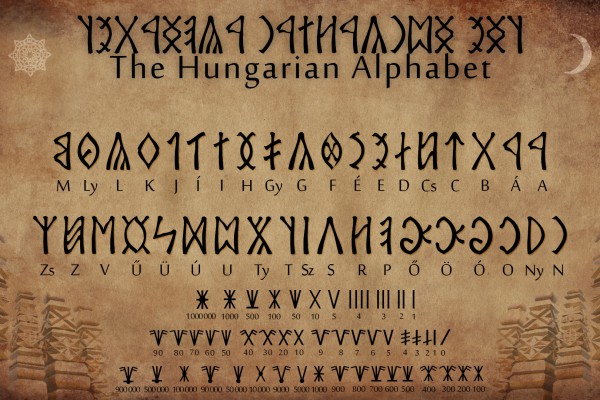
The Hungarians at the time of their settlement in the Carpathian basin, and their eastern relatives used a common alphabet called in Hungarian “rovás” or Hungarian ‘runic’ alphabet. The uniqueness of this form of written communication is that it enabled the Hungarian language to be represented phonetically, without the need of accent marks or combination letters as is necessary with the modified Latin alphabet, or even in English. Every Hungarian sound has its own separate letter represented by a symbol which with a little imagination looks like a recognizable basic item that starts with that letter. They also had special numeric symbols much like the Roman numerals, except closer to its earlier Etruscan form. Another interesting element of this Hungarian runic script, is that the letters and words were written from Right to Left.
This ancient alphabet and writing system was almost lost because of various forms of suppression and the eventual adoption of the basic Latin / Roman alphabet system used by the rest of Western Europe. However thankfully due to fantastic efforts of Hungarian Linguists, Szekler Hungarians in Transylvania and the National Government of Hungary (in recent times) this ancient recognised alphabet has been preserved and has even shown a massive interest by Hungarians today and scholars of ancient cultural studies.
Music – Hungarians have registered 200 000 Folksongs
A Hungarian music institute has registered 200 000 Hungarian folksongs, with more than a 100 000 in print format. The German by comparison with their own rich cultural heritage have around 6000 folksongs!

Hungarian folk music (Magyar Népzene) includes a wide array of Hungarian ethnic music styles, including the recruitment dance – verbunkos, the csárdás and nóta. This music had a great influence on Central European music culture. Népzene – Hungarian folk music, is an umbrella term for a huge number of related styles of traditional folk music from Hungary and across those Hungarian minorities still living in modern-day Austria, the Czech Republic, Slovakia, Poland, Ukraine, Slovenia, Croatia, Serbia, in Transylvania especially amongst the Székely Magyars, and in Moldova as practised by the Csángó Magyars. Népzene’s broader popularity was largely thanks to the famous Hungarian composer Franz Liszt, who after 1846 composed 19 Hungarian Rhapsodies for piano, five of which were later orchestrated, thus being the first pieces of music by a major composer to incorporate sources from so-called “Hungarian peasant music”. These music works, broke free from classical tradition, and were destined to deeply influence other music greats such as Johannes Brahms, and later the Hungarian composers Zoltán Kodaly and Béla Bartok. This music even influenced American jazz!
